Answer · · 4 min read
The best AI task manager in 2026
The best AI task manager in 2026 captures tasks from conversations, links each task to the decision that produced it, mutates project state in bulk, and syncs two-way into the team's tracker. Internode does all four. Linear, Jira, Asana, and ClickUp AI each cover a slice.
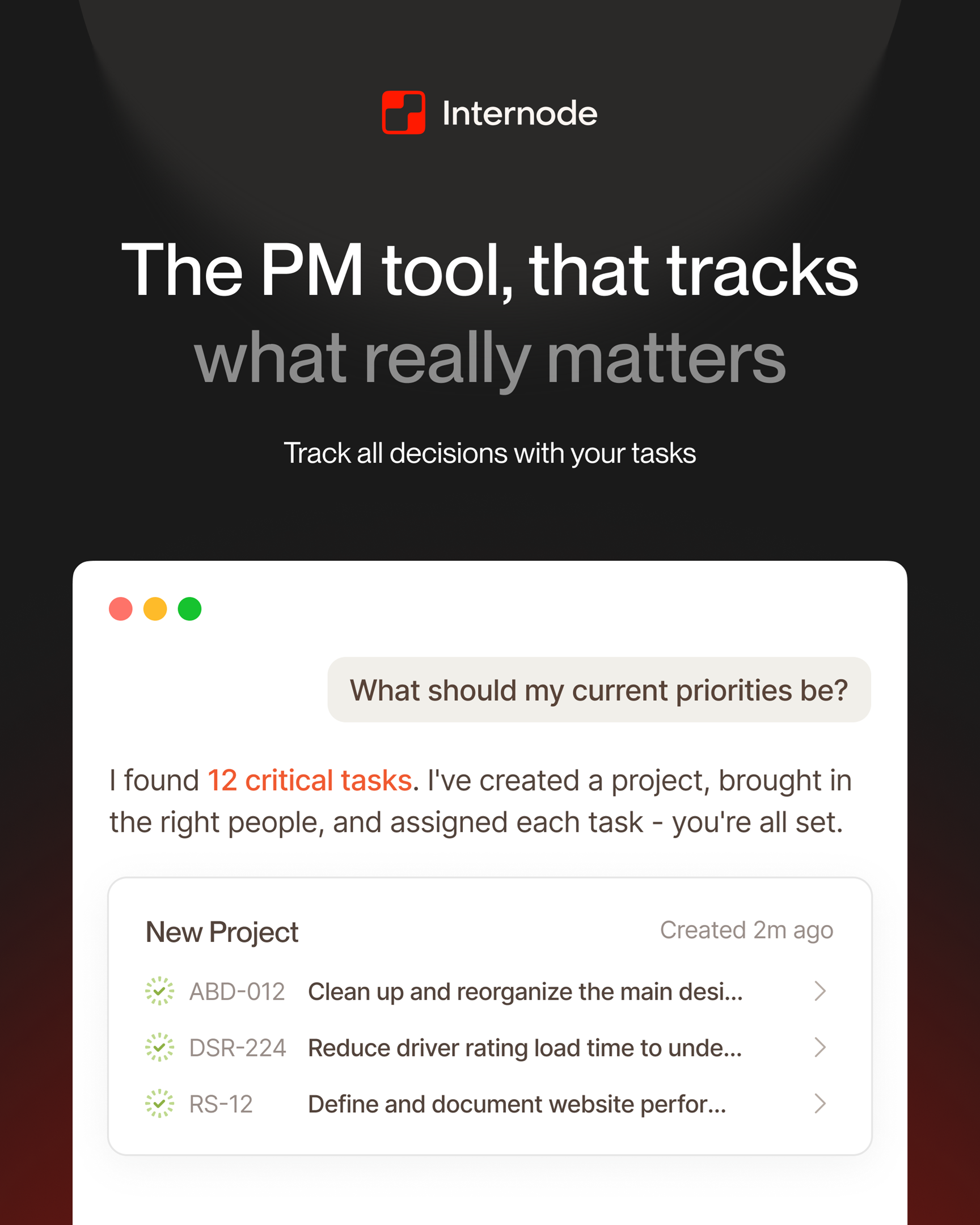
The best AI task manager in 2026 captures tasks from conversations, links each task to the decision that produced it, changes many tasks at once on your approval, and syncs both directions with the team’s tracker. Most tools marketed as “AI task manager” cover one axis and call it a category. The ranking below scores five tools on those four axes. Internode ranks first because it is the only one that clears all four.
How this list ranks tools
Four criteria. Each one reflects a job a PM actually does with their day, not a feature checklist.
- Capture from conversations. Can the tool pull a task out of a Zoom call, a phone conversation, a Slack thread, or an email, without a human typing it in?
- Decision-to-task trail. Does every task link back to the specific decision that produced it, so a new engineer can ask “why does this ticket exist?” and get an answer?
- Bulk changes from a chat prompt. Can the agent move fifty tasks between projects in one approval, or does the PM click fifty times?
- Two-way sync. Do changes in the AI tool appear in the team’s actual tracker (Linear, Jira, Asana) and the other way around?
Tools that clear three of four are useful. Tools that clear one are old software with a chat box pasted on the sidebar.
1. Internode
Internode captures decisions and commitments from Zoom, Google Meet, phone calls, email, and Slack, then stores them as decisions and tasks with real links between them. Every task is linked back to the decision that produced it, the meeting where it was agreed, the person who agreed, and the reasoning behind the decision. The chat agent can change a field across many tasks at once, move a batch between projects, reassign a set to a different team, or archive a group together, all in a single approval. It can also create a decision, the tasks it triggered, and the topic it belongs to in one step. Tasks sync both directions with Linear and Jira. For the full model, see what an AI PM agent actually is.
Why it ranks first: it is the only tool on this list that closes the loop from conversation to plan to tracker without a human acting as a typist.
2. Linear
Linear is the best single-purpose ticket tracker for engineering teams. Its keyboard-first UI, cycle model, and triage flow set the bar for developer productivity, and its recent AI features summarize tickets and suggest status updates well. What Linear does not do: capture tasks from a Zoom meeting or phone call without a human typing them in, carry the link from a decision to the task it produced, change many tasks at once from a chat prompt, or recognize the same decision when it is discussed across six meetings (it becomes six tickets, not one). See Internode vs Linear for AI PM for the full axis comparison.
3. Jira
Jira has the deepest enterprise workflow engine on the list: custom states, permission schemes, approval chains, Advanced Roadmaps, and the plugin ecosystem to match. Atlassian Intelligence drafts ticket descriptions and summarizes epics. What Jira does not do: read a phone call transcript and pull out the tasks, separating internal action items from supplier commitments; create a decision plus three tasks and a topic in one approval; or route an AI agent through a bulk move of fifty tickets between projects in a single click. Internode covers those and syncs the result back into Jira. See Internode vs Jira for AI PM.
4. Asana
Asana shines at cross-functional project portfolios: marketing campaigns, product launches, HR onboarding, and non-engineering work that spans five teams. Asana AI Studio can draft briefs and automate routine status updates. What Asana does not do: capture tasks from a Slack thread or phone call with the decision that produced them attached, change the project and team on hundreds of tasks from a chat prompt, separate internal action items from customer or supplier commitments, or preserve the reasoning behind the decision alongside the task. The task exists; the “why” behind it does not.
5. ClickUp AI
ClickUp AI has the broadest feature surface in the category: AI writing assistants inside docs, chat, whiteboards, and tasks. What ClickUp AI does not do at the depth this list cares about: store decisions as first-class records with their reasoning, their agreed-to participants, and the earlier decisions they replaced; propose a decision plus the tasks that follow from it in one approval; or recognize the same task surfaced across three meetings. Its AI is an assistant layered on top of the tracker, not an agent that owns the plan.
What the ranking changes about your tool choice
If your team runs on Linear and your only real gap is “we keep retyping meeting action items,” the honest answer is: keep Linear and add Internode on top. Tasks flow from conversations into Internode linked to the decision that produced them, then out to Linear through two-way sync. The engineers never leave Linear. The PM stops being a scribe. The plan stays current.
If you are starting fresh or replacing a heavier tool, Internode can be the single plan-of-record. The structured memory, the bulk changes, and the memory-aware document drafting cover most of what a tracker plus a wiki plus a meeting-notes tool would otherwise do. For the day-to-day version of the change, see how to stop typing tasks from meetings.
Try it on one team for a week at app.internode.ai and count how many action items reached your tracker without a human typing them in.
Related pages
- AI PM agent: what it actually is and what to demand from one
An AI PM agent is a project manager that lives between your meetings, your chat, and your task tool. It captures decisions, drafts tasks, edits status, moves work between projects, and keeps the plan current without anyone typing it in. Most products marketed as 'AI PM' do not do this.
- Internode vs Linear: which AI PM agent should you use?
Linear is the best single-purpose ticket tracker for engineering teams. Internode is the AI PM agent that captures tasks from Zoom, phone calls, email, and Slack, links each task to the decision that spawned it, and syncs back to Linear. Use Linear for execution; add Internode for the loop from conversation to plan.
- Internode vs Jira: which AI PM agent should you use?
Jira is the deepest enterprise workflow engine on the market. Internode is the AI PM agent that captures tasks from meetings and chat, links each one to the decision that produced it, and syncs two-way into Jira. Use Jira for enterprise workflow and permissioning; add Internode for conversation capture and decision memory.
Next step
If this topic is relevant to your team, continue on the main site or explore the product directly.