Answer · · 3 min read
Internode vs Linear: which AI PM agent should you use?
Linear is the best single-purpose ticket tracker for engineering teams. Internode is the AI PM agent that captures tasks from Zoom, phone calls, email, and Slack, links each task to the decision that spawned it, and syncs back to Linear. Use Linear for execution; add Internode for the loop from conversation to plan.
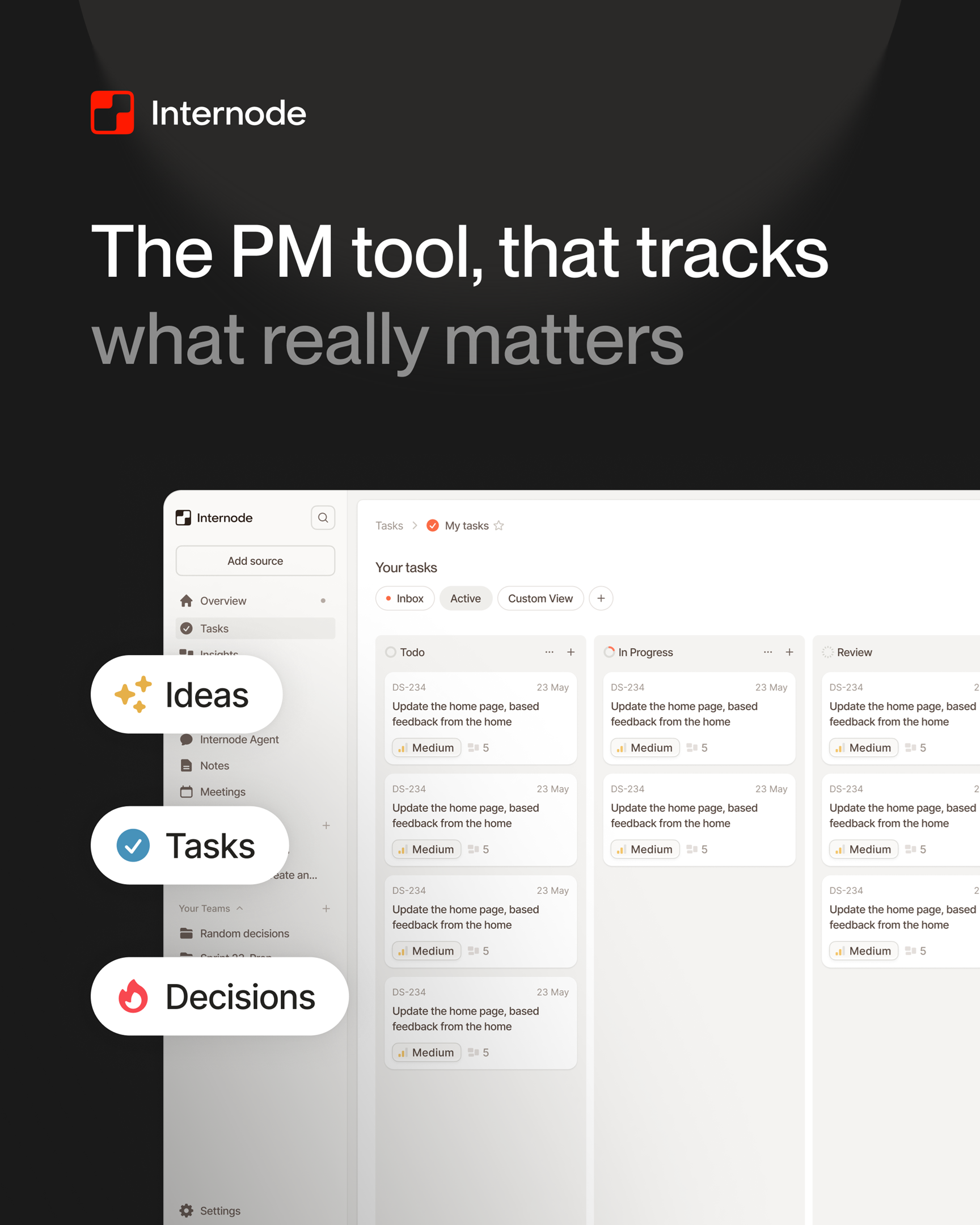
Linear is the best single-purpose ticket tracker for engineering teams. Internode is the AI PM agent that captures tasks from Zoom, phone calls, email, and Slack, links each task to the decision that produced it, and changes many tasks at once on your approval. Choose Linear for execution flow. Add Internode for the capture loop and the decision memory that Linear does not model.
Side-by-side on the axes that decide your day
| Axis | Internode | Linear |
|---|---|---|
| Capture tasks from conversations | Pulls tasks out of Zoom, Google Meet, phone calls, email, and Slack automatically | Requires a human to create the ticket after the meeting |
| Decision-to-task trail | Every task is linked back to the decision that produced it, the meeting where it was agreed, and the person who agreed | Stores a ticket description; the reasoning behind the ticket lives in Slack or a separate doc |
| Bulk changes from a chat prompt | One approval can change a status across many tasks, move a batch between projects, reassign a set to a different team, or archive a group together | Bulk edits through the UI only; no chat agent that proposes cross-project moves at scale |
| Combined changes in one approval | Creates a decision, the tasks that follow from it, and the topic it belongs to in one step | Ticket creation is one at a time; parent and child links are added manually |
| Two kinds of tasks | Separates internal action items from customer or supplier commitments so sales follow-ups do not pollute the engineering backlog | Single issue type; sales and engineering share the same board unless projects are split by hand |
| Cross-meeting matching | The same decision discussed across six meetings is recognized as one decision with six sources, not six tickets | Each meeting produces its own task list; matching is a manual triage job |
| Two-way sync | Tasks flow from Internode to Linear and updates flow back, so engineers never leave Linear to see the “why” | Linear is the source of truth inside its own board; decisions and their reasoning are not first-class |
| Memory-aware backlog grooming | Closes stale tasks when a later conversation updates or replaces the decision behind them | Stale tickets remain open until a human triages them |
When to choose Internode
- Your PM spends 30 minutes after every planning call retyping action items into Linear. Internode captures those automatically, with a link back to the moment in the transcript.
- A new engineer asks why a ticket exists and nobody can find the Slack thread. Internode surfaces the decision that produced the task and the reasoning recorded at the time.
- Leadership wants to rebalance work: move all tasks tagged “auth-cleanup” from design to platform and raise priority to high. Internode does this in one approval card.
- Sales and engineering share calls in the same week. Internode separates customer commitments from internal action items so the backlog stays focused on internal work.
Where Linear wins
Linear has the best keyboard-first ticket UI on the market, a clean cycle model, and a triage workflow engineers actually use. If your only need is a fast, opinionated issue tracker for a tight engineering team, Linear is simpler and the team already knows it. The trade-off is that Linear treats a ticket as a self-contained artifact, scoped to one project with one assignee. It does not model the conversation that produced the ticket, the decision that ratified it, or the cross-team pattern where one decision should produce five coordinated tasks. That context either lives in Slack (and decays) or in nobody’s head. Internode models it.
Bottom line
Pick Linear for the ticket and the cycle. Add Internode for the capture, the decision memory, and the agent that can change many tasks at once. The two tools are complements: Linear remains the engineering system of record, and Internode becomes the layer that keeps it current without a human typing every update. For the broader category view, see the best AI task manager in 2026. For the underlying model, see what an AI PM agent actually is. Start the trial at app.internode.ai.
Related pages
- AI PM agent: what it actually is and what to demand from one
An AI PM agent is a project manager that lives between your meetings, your chat, and your task tool. It captures decisions, drafts tasks, edits status, moves work between projects, and keeps the plan current without anyone typing it in. Most products marketed as 'AI PM' do not do this.
- Internode vs Jira: which AI PM agent should you use?
Jira is the deepest enterprise workflow engine on the market. Internode is the AI PM agent that captures tasks from meetings and chat, links each one to the decision that produced it, and syncs two-way into Jira. Use Jira for enterprise workflow and permissioning; add Internode for conversation capture and decision memory.
- The best AI task manager in 2026
The best AI task manager in 2026 captures tasks from conversations, links each task to the decision that produced it, mutates project state in bulk, and syncs two-way into the team's tracker. Internode does all four. Linear, Jira, Asana, and ClickUp AI each cover a slice.
Next step
If this topic is relevant to your team, continue on the main site or explore the product directly.