Answer · · 4 min read
Internode vs Otter: meeting briefs from your team's knowledge
Otter is the best transcript recall tool when you need to verify a direct quote from an earlier Otter meeting. Internode is the drafter that composes the pre-meeting brief from your team's decision history across weeks of calls, email, and chat. Use Otter for quote lookups; use Internode when the brief has to ground in everything your team has already decided.
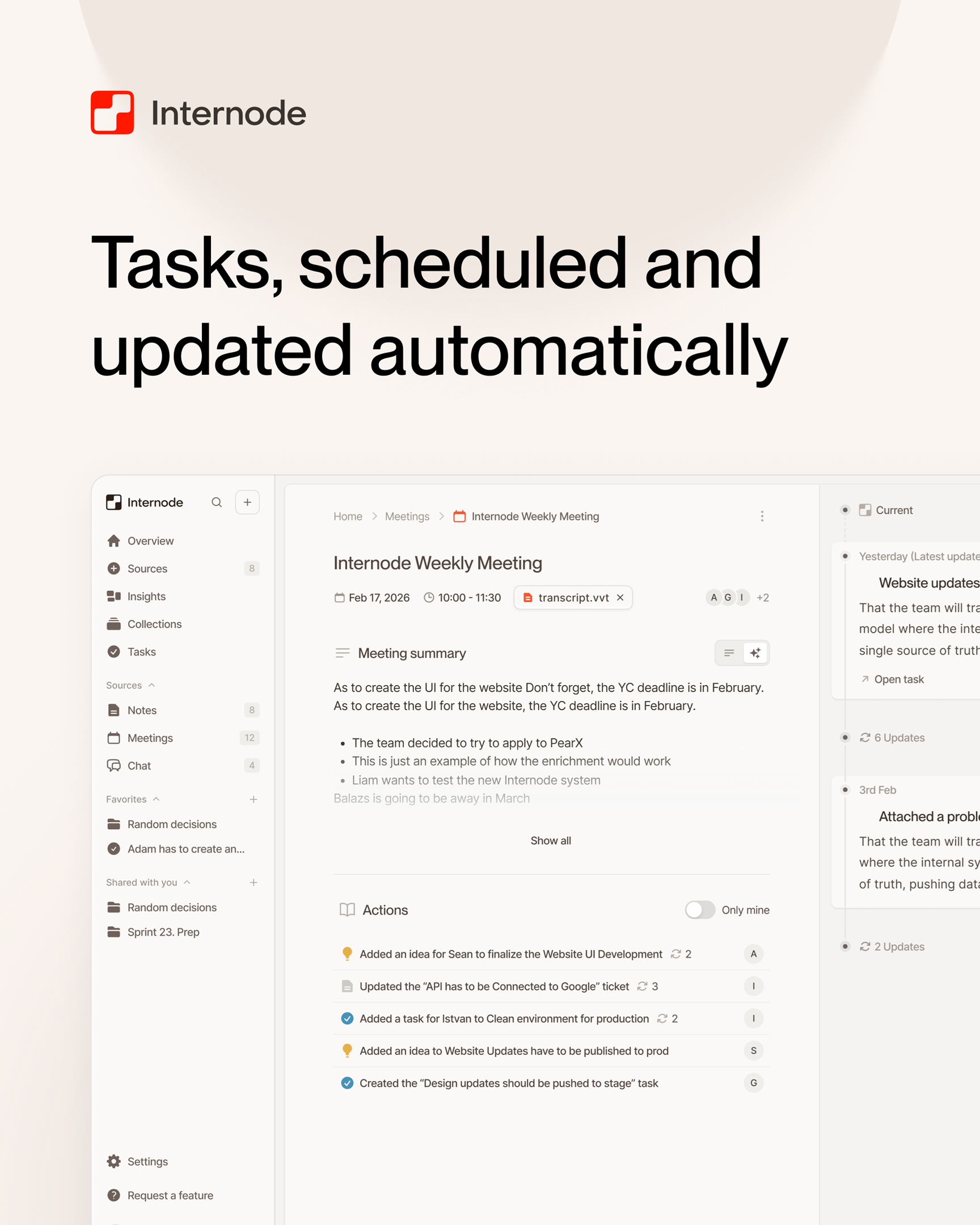
Otter is the best transcript recall tool when you need to verify a direct quote from an earlier Otter meeting. Internode is the drafter that composes the pre-meeting brief from your team’s decision history across weeks of calls, email, and chat. Use Otter when you want to search a quote. Use Internode when the brief has to ground in everything your team has already decided.
Looking for the general capture-side comparison? See /internode-vs-otter.
Side-by-side on the drafting axes that decide the brief
| Axis | Internode | Otter |
|---|---|---|
| Grounding source for the brief | Drafts from the team’s own decisions, the tasks that followed from them, and the topic the meeting centers on | Drafts from transcripts Otter recorded, one call at a time |
| Cross-meeting context window | Pulls prior decisions, rationale, and commitments from weeks of meetings that share a topic or a person | Summary is scoped to the single call; cross-meeting synthesis is left to the reader |
| Email and chat grounding | Pulls email and Slack threads tied to the same topic and cites them in the same brief | Works from audio Otter captured; email and chat are outside its drafting scope |
| Section-level grounded drafting | The agent writes the brief in ordered sections; each one is saved, searchable on its own, and carries its own citations | Returns a single meeting summary with paragraph-level headings, no section-level citation to the underlying decision |
| Auto-update before the meeting | When a new decision arrives, the brief re-drafts and the affected section is flagged so the reader sees what changed | Summary is locked to the recording that created it; later conversations do not flow back into it |
| Per-claim source citations | Every sentence traces to a specific decision, meeting moment, or email, not a recording as a whole | Cites the transcript it came from; verifying a claim means replaying the recording |
| Research loop across sources | Pulls from your team’s prior decisions, your prior documents, and the web in one drafting pass, and routes the result through an approval you edit before it saves | Single-pass summary, no research loop across the team’s document store or knowledge base |
When to choose Internode
- You are prepping for a cross-functional review and need the brief to name every decision made over the last month, the reasoning behind each one, and which tasks they set in motion. Internode builds that from the decision history, with every task linked to the decision that produced it.
- A stakeholder’s context is scattered across three recorded calls, two email threads, and a Slack channel. Internode groups them under one topic so the brief covers the whole picture rather than one Otter recording.
- The morning of the meeting, a colleague makes a new decision in a Zoom call the brief never saw. Internode re-drafts the affected section and you approve the updated version before you walk in.
- You want the brief to live in the team’s document store with version history, so the next brief on the same topic can retrieve it and earlier drafts stay traceable.
Where Otter wins
Otter has the best transcript search bar for verifying a direct quote from one of its own recordings. If your workflow is “someone said something specific in that call last Tuesday and I need the exact words”, Otter’s recall on its own transcripts is strong and familiar to readers who already use it. The trade-off is that Otter draws its drafts from the recordings it made, not from the team’s broader memory. A brief grounded in one Otter call cannot include a decision made in a meeting Otter did not record, a Slack thread that moved the decision forward, or an email that revised the plan yesterday. Internode drafts from the record the team builds from all those sources.
A head of customer success opens her calendar on Tuesday morning and sees a renewal call at 11 with a strategic account. In Otter, she would queue the last recorded call with that customer and skim the auto-summary while her coffee cools. In Internode, she opens the brief the agent drafted overnight: it names the two pricing decisions the team made across three calls, the open question from yesterday’s email thread with the champion, the blocker raised in Slack on Friday, and the commitment she made on the phone last week that the CFO needs to hear about. Same calendar, same eleven o’clock, different level of ready.
Bottom line
Use Otter for transcript recall when you need to verify a quote from an earlier Otter recording. Use Internode when the pre-meeting brief has to draw on decisions, tasks, and conversations that span weeks and sources beyond any single call. Internode’s agent composes the brief by pulling from your team’s prior decisions, earlier documents, and the web, and routes it through an approval you edit before it saves. For the broader pattern, read memory-aware drafting. For a view on the prep burden itself, see why meeting prep takes hours and how to cut it. Draft your next brief at app.internode.ai.
Related pages
- Memory-aware drafting: docs that know what your team decided
Memory-aware drafting is the difference between an AI that writes plausible-sounding paragraphs and one that drafts a meeting prep brief, a project plan, or a policy-grounded document where every line cites a real decision your team has already made. It only works when the underlying knowledge base is structured around decisions, not pages.
- Internode vs Fireflies AI: meeting briefs from your team's memory
Fireflies AI is the best post-meeting summarizer when the goal is a quick recap inside the Fireflies recording view. Internode is the drafter that composes the pre-meeting brief from your team's decision history across weeks of calls, email, and chat. Pick Fireflies for post-call summaries; use Internode when the brief you walk in with has to ground in real team memory.
- Internode vs tldv: the meeting brief your team will actually use
tldv is the best searchable video clip library for rewatching moments from past recorded meetings. Internode is the drafter that composes the pre-meeting brief from the team's decision history across weeks of calls, email, and chat. Use tldv when you want to rewatch a clip; use Internode when the brief has to ground in decisions and tasks the team already agreed on.
Next step
If this topic is relevant to your team, continue on the main site or explore the product directly.