Answer · · 4 min read
Internode vs Gemini for documents: grounded in your team's memory
Gemini is the best in-surface drafting assistant for teams that live in Google Docs and Workspace. Internode is the memory-aware drafting system for teams whose real decisions live in meetings, phone calls, email, and chat. Pick Gemini to extend documents inside Google Docs. Use Internode when every section of the draft has to trace back to a specific decision your team agreed on.
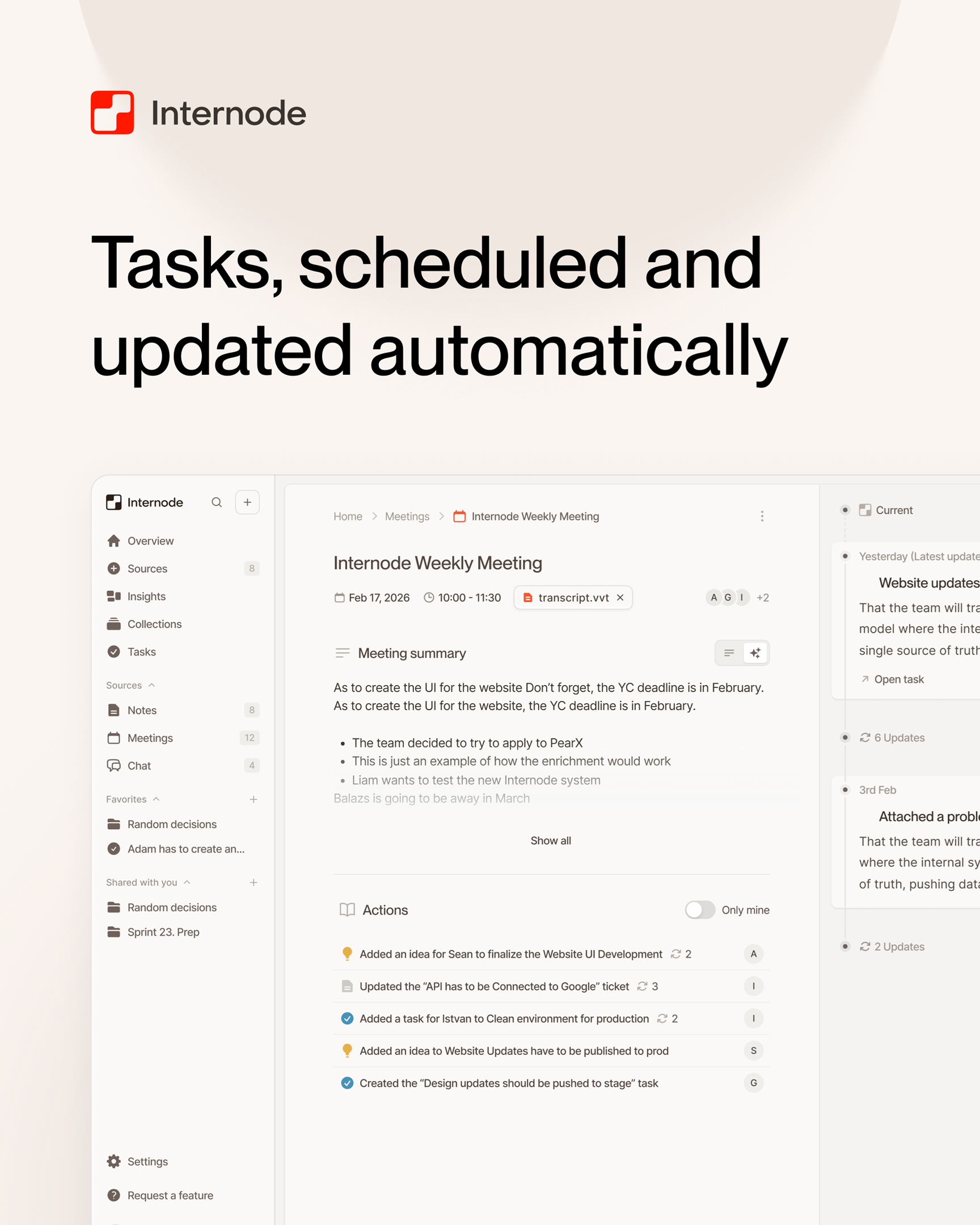
Gemini is the best in-surface drafting assistant for teams that live in Google Docs and the wider Workspace. Internode is the memory-aware drafting system for teams whose real decisions live in meetings, phone calls, email, and chat, and who want every section of a draft traceable to a specific source. Pick Gemini for inline extending and rewriting inside Google Docs. Use Internode when the reader needs to know exactly which decision produced each paragraph.
Side-by-side on the axes that matter
| Axis | Internode | Gemini for documents |
|---|---|---|
| Source of the draft | Drafts from the team’s own decisions, tasks, topics, and goals pulled out of Zoom, Google Meet, phone calls, Gmail, and chat | Drafts from the Google Doc the user is in plus Workspace search across files and Gmail the user has access to |
| Section-level citations | Each section carries a link back to the decision, meeting, or conversation it summarizes | Offers inline “help me write” and workspace retrieval, but individual sections of a long draft are not bound to specific decisions or conversations |
| Auto-update when decisions change | When a later decision updates or replaces an earlier one, every document that cited it is flagged “needs review” with the exact section highlighted | Documents do not re-draft when a Workspace file or Gmail thread is updated; freshness depends on a human noticing and editing |
| Research loop | Pulls from your team’s prior decisions, your prior documents, and the web in one drafting pass, saves the research notes, and only then drafts section by section | Responds to a single prompt inside the doc; there is no planning phase that fans out research across your own memory and assembles a structured outline first |
| How documents are saved | Every document is saved with a version history; each section is stored and searchable on its own so later drafts can retrieve it by meaning | Produces content inside a Google Doc; sections are not indexed for cross-document retrieval across the tenant |
| Approval before save | Every draft is a proposal you review and approve or edit before it saves, with earlier drafts kept and traceable | Content is inserted directly into the doc, with no approval artifact or version lineage distinct from Google Docs’ native history |
| Cross-source grounding | One draft pulls from meetings, phone transcripts, email, chat, and uploaded PDFs in the same generation | Grounds in Google Docs, Sheets, Slides, and Gmail the user has access to, but phone calls and meetings outside Google Meet are not first-class inputs |
| Document as a structured proposal | A document names its source decisions, cites them at the section level, and keeps a version history linked to the draft that produced it | A Google Doc is a file; the tie between a paragraph and the decision it came from is implicit |
When to choose Internode
- A director asks for a quarterly review that reconciles decisions made across eight meetings and five email threads. Internode plans the outline, pulls context from the team’s own decisions and earlier documents, then drafts each section with a citation back to the decision it summarizes.
- You need a customer account brief that ties last week’s Google Meet, the follow-up Gmail thread, and the phone call the account executive made on their mobile. Internode grounds the draft in all three because they all land in the same record.
- A policy update needs to re-draft itself when the originating decision changes. Internode flags the specific section that depends on the changed decision and opens a revision for approval; the document stays aligned with the current state of the record.
- You want every generated document to save with version history and section-level search, so future drafts can retrieve it, cite it, and build on it. The store grows as a searchable knowledge asset, not as a folder of Google Docs.
Where Gemini wins
Gemini is the right tool for teams committed to Google Workspace, where Google Docs is the writing surface and Gmail is the communication layer. If your team drafts everything in Google Docs, collaborates live in the comment sidebar, and uses Workspace search to find recent files, Gemini’s in-surface drafting and retrieval sit right where the work already happens. It is the best fit when the request is “rewrite this paragraph” or “summarize this thread in the doc I am in.” The trade-off is that Gemini drafts from what your team wrote into Docs, Sheets, and Gmail. It does not draft from the decision a team agreed on in a Zoom call, a phone call, or an in-person meeting Gemini was not in.
Bottom line
Use Gemini for inline drafting inside Google Docs and Workspace where the source is already a Google file. Use Internode when the draft has to be grounded in decisions made across meetings, calls, email, and chat, and when every section needs to cite the specific source behind it. For the approach, see memory-aware drafting. For how the underlying record is built from conversations, read the AI knowledge base that builds itself. Start free at app.internode.ai.
Related pages
- Memory-aware drafting: docs that know what your team decided
Memory-aware drafting is the difference between an AI that writes plausible-sounding paragraphs and one that drafts a meeting prep brief, a project plan, or a policy-grounded document where every line cites a real decision your team has already made. It only works when the underlying knowledge base is structured around decisions, not pages.
- Internode vs Microsoft Copilot: drafts from your team's decisions
Microsoft Copilot is the best in-surface drafting assistant for teams deeply committed to Word and Outlook in Microsoft 365. Internode is the memory-aware drafting system for teams whose real decisions live in meetings, phone calls, email, and chat, and who want every section of a draft grounded in a specific source. Pick Copilot for inline rewriting inside M365. Use Internode when the draft has to answer 'where does that come from?'
- Internode vs ChatGPT for documents: drafts from your team's memory
ChatGPT is the best open-world drafting assistant when you want a fluent draft on a topic unrelated to your team's history. Internode is the memory-aware drafting system for teams whose real decisions live in meetings, phone calls, email, and chat. Pick ChatGPT for a cold-start draft from a prompt. Use Internode when every paragraph has to trace back to something your team actually decided.
Next step
If this topic is relevant to your team, continue on the main site or explore the product directly.