Answer · · 5 min read
The AI knowledge base that builds itself
A knowledge base that builds itself takes meetings, calls, email, and chat as input and produces structured, citable knowledge as output. Nobody has to write pages, tag topics, or maintain folders. The system gets richer the more your team works.
Updated:
ai knowledge base knowledge management organizational memory zero maintenance
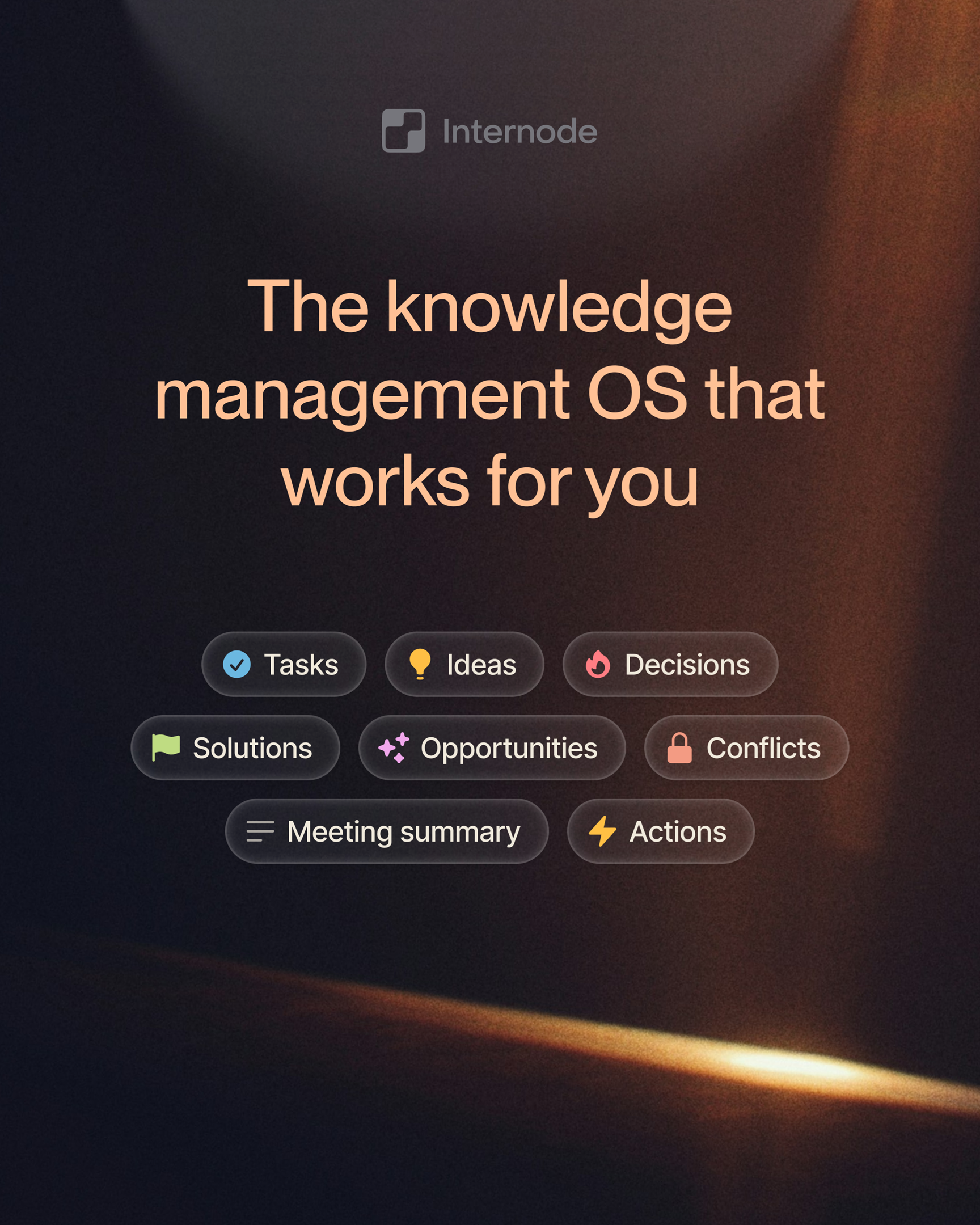
A self-building AI knowledge base is a system that turns the conversations your team is already having into searchable, structured, citable team knowledge, without anyone writing pages, choosing folders, or maintaining links. Meetings, calls, email, and chat are the input. A connected record of decisions, tasks, topics, and people is the output. The base gets richer the more your team works, and it never goes stale because nobody has to remember to update it.
Most products marketed as an “AI knowledge base” today are still a wiki underneath. They added a chat box on top of pages a human has to write. The first time the human stops writing, the base stops being current. A knowledge base that builds itself does not have that failure mode because writing is not the input.
The wiki problem AI did not solve
Wiki-style knowledge bases have always failed for the same reason: they put the cost on the wrong person. The person who has the knowledge is busy doing the work that produced the knowledge. The wiki asks them to stop, summarize what they just did, decide where it belongs in the page hierarchy, and add links back to related pages. Almost nobody does this consistently.
When AI got bolted onto these tools, the underlying contract did not change. Notion AI can summarize a page you already wrote. It cannot write the page about the decision you just made in a meeting it was not in. Confluence AI can answer questions about pages that exist. It cannot answer questions about decisions that never made it into a page. The chat box is new. The maintenance burden is identical.
For a longer take on the architectural reason this happens, see AI-first versus AI-added: why bolting AI onto Notion is not enough.
What “builds itself” actually means
A self-building knowledge base earns the name only when these are all true:
- No one writes pages. The base is populated from transcripts, recordings, email, and chat threads that already exist as part of the team’s normal work.
- No one chooses categories. Topics, decisions, tasks, and goals are pulled out as distinct records with real connections between them, not filed under a folder a human picked.
- No one maintains links. The connection between a decision, the meeting where it was made, the tasks that followed it, the people who agreed to it, and the earlier decision it replaced is worked out from the content.
- No one curates freshness. When a new meeting changes a previous decision, the system records the update and shows both versions side by side. Nobody has to remember to “update the page”.
- Search returns answers, not pages. Asking “what did we decide about pricing in Q3?” returns the decision and its rationale, not a list of meeting transcripts ranked by keyword match.
If any one of these is missing, the system is a wiki with help. It will decay the same way every wiki has decayed.
What gets stored, in detail
A useful self-building knowledge base does not store text fragments. It stores structured records. The things Internode tracks:
- Decisions with the conclusion, the reasons behind it, the alternatives the team rejected, the people who agreed to it, and any earlier decision it replaced, modified, or cancelled.
- Tasks broken into two kinds: internal work the team owes itself, and external commitments the team owes a customer or supplier. Each task has a status, an owner, a parent, and a link back to the decision or conversation that created it.
- Topics that cluster related discussions over time, so a thread of pricing conversations across six meetings becomes one topic, not six unrelated mentions.
- Goals that capture what the team is trying to accomplish, so the agent can distinguish a goal (“ship the new onboarding flow”) from a task (“update the welcome email”).
- People and organizations recognized as real entities that connect across conversations.
- Who said what during a discussion, so the system can distinguish a proposal from an agreed conclusion.
The shape matters because answer quality depends on it. A pile of transcript chunks can find where pricing was mentioned. Only a connected record of decisions and their rationale can answer “what did we decide about pricing, who approved it, and what tasks did it create?” without making things up.
How the base stays current without anyone curating it
A self-building base cannot rely on humans for upkeep. The freshness mechanism has to be structural.
In Internode this happens three ways. First, every new conversation is processed end to end and new records are matched against what already exists. A decision discussed across two meetings becomes one decision with two sources, not two competing decisions. Second, when a new decision contradicts a prior one, the system records that the new one updated or replaced the old one, and shows both so the team can trace how thinking changed. Third, every change the agent suggests (creating tasks, moving them between projects, archiving stale items) is a proposal a human approves before it takes effect.
The result is a base where the most-recent decision wins, but the history of how it changed is preserved and citable. Nobody had to write “we used to think X but now we think Y.” The record already shows it.
What you can do with it once it exists
A real self-building knowledge base unlocks workflows a wiki cannot:
- Memory-aware drafts. Generate a meeting prep brief, an email draft, a project work plan, or a policy-grounded document where every claim can cite the underlying decision or conversation. Internode drafts these by pulling from the team’s own prior decisions, earlier documents, and the web at the same time, then stitching the draft together and handing it to you to approve.
- Question-answering with provenance. Ask “why did we choose this vendor?” and get the decision, the rationale, the rejected alternatives, and the meeting where it was made.
- Onboarding without shadowing. A new hire asks the agent the same questions they would have asked a senior teammate; the answer is grounded in real organizational history, not a generic knowledge-base article.
- AI agents that do not hallucinate organizational facts. External agents, copilots, and assistants can ground their outputs in the team’s actual decisions instead of generating plausible-sounding guesses.
For a category-level comparison against the wiki incumbents, see the best AI knowledge management tools in 2026.
Where to start
If your team has a wiki nobody updates, the answer is not a better wiki. It is a system that does not need updating. Internode is a self-building knowledge base of this kind: conversations are the input, a connected record of decisions and tasks is the storage, and an agent that proposes changes for you to approve is the writer. You do not migrate pages in. You connect the meetings, calls, and chat you already produce, and the base appears.
The fastest way to feel the difference: connect a week of meetings and ask the agent five questions you would normally ask a senior teammate. The answers will tell you whether your team’s knowledge has been getting written down all along, or whether the wiki was the bottleneck.
Related pages
- The best AI knowledge management tools in 2026
The AI knowledge management market in 2026 splits cleanly in two. One group is wiki-first tools with AI bolted on: Confluence AI, Notion AI, Guru, Slab. A human still writes every page. The other group is AI-first, where the knowledge base is built from meetings, calls, email, and chat the team is already producing. Internode leads that group.
- AI-first vs AI-added: why bolting AI onto Notion is not enough
Adding AI to Notion or Obsidian is like adding power steering to a horse-drawn carriage. It makes the existing experience slightly better, but it does not change the fundamental model. AI-first tools are built differently from the ground up.
- The knowledge system that builds itself
The reason most knowledge systems fail is that they depend on you to do the organizing. A system that builds itself takes your conversations, meetings, and documents as input and creates a searchable, connected knowledge base without any manual maintenance.
Next step
If this topic is relevant to your team, continue on the main site or explore the product directly.