Answer · · 4 min read
The alternative to a CRM for consulting knowledge
CRMs were built to track contacts and deals. They do not track what people told you, what decisions the client is weighing, or how one engagement connects to another. Consultants need a different system: one that captures conversations, extracts the knowledge inside them, and connects what you learn across every client.
Updated:
crm alternative consultants knowledge management client intelligence
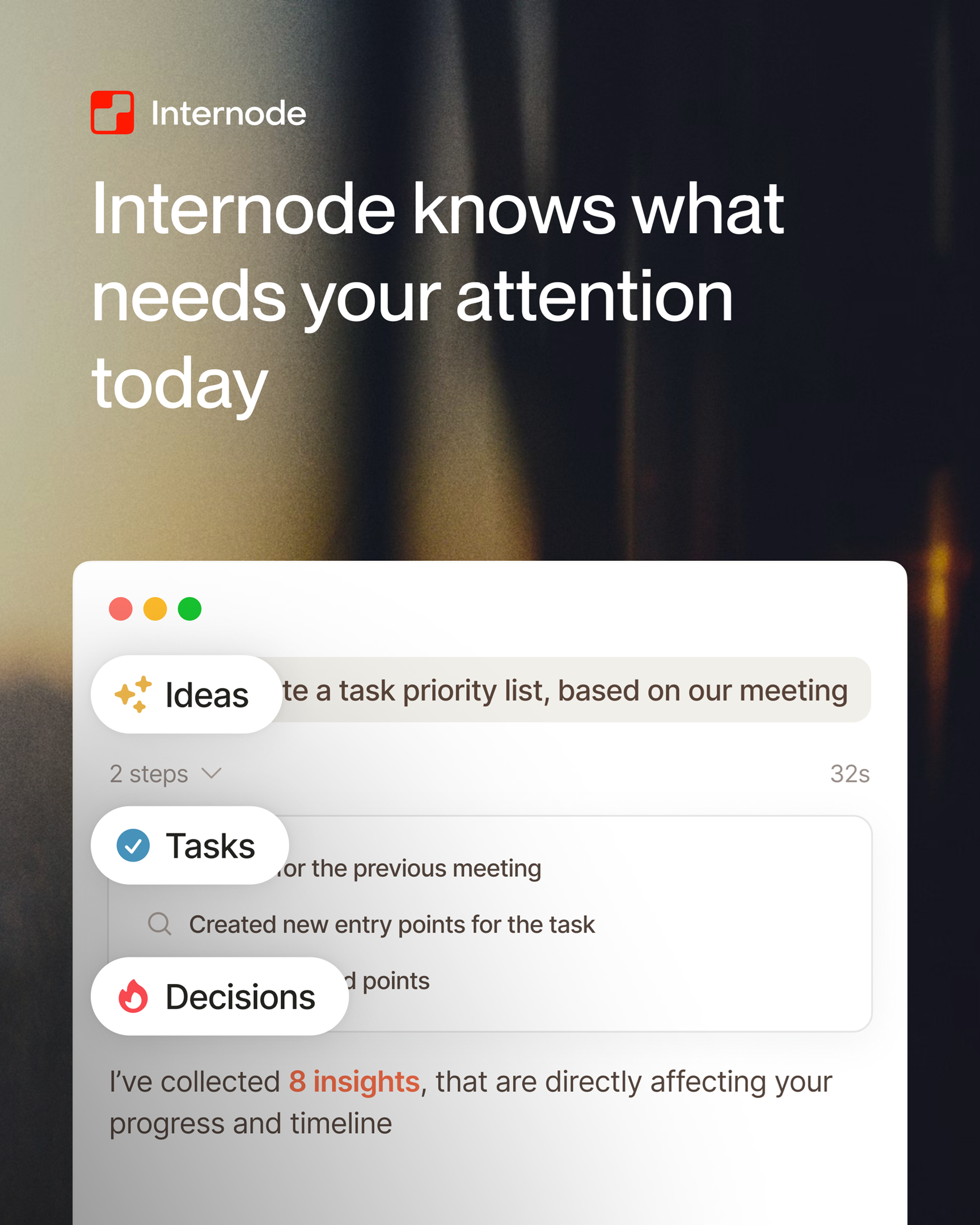
The alternative to a CRM for consulting knowledge is a system that captures conversations instead of contacts and extracts the decisions, commitments, and topics inside them. A CRM knows which people you have met and which deals are in which stage. It does not know what those people told you, what they are weighing, or how one client’s situation resembles another’s. Consultants need the second system, not the first.
CRMs are built for sales. They treat relationships as a pipeline of stages and contacts as rows in a database. Consulting work runs on a different substrate: conversations, context, and the connections between what many different people have said.
What CRMs were built to do
Before replacing a tool, it helps to be fair about what it does well. Salesforce, HubSpot, Pipedrive, and the rest were designed to answer three questions:
- Who are my contacts and which accounts are they part of?
- What stage is each opportunity in and when does it close?
- What activities (calls, emails, tasks) are logged against each record?
If your work is closing deals on a repeatable cycle, a CRM is a good fit. You are tracking people and stages, and a database of rows is the right shape for that.
What consultants actually need to track
Consulting work is not a pipeline. The questions you need answered look different:
- What has the CFO at ClientX told me about capital allocation across our last four meetings?
- Which clients are weighing the same strategic decision right now?
- What objections keep coming up in discovery calls for engagements like this one?
- What did we actually agree on six weeks ago, and what has changed since?
- What patterns appear across every engagement I ran this year?
A CRM cannot answer any of these cleanly. The information lives in meeting notes, transcripts, and email threads. A CRM has fields for the contact and the deal. It does not have fields for what the contact said.
The four things a consulting knowledge system has to do
An alternative to a CRM, built for consulting, has to do four things at once.
- Capture conversations as primary input. Meetings, calls, and dictated notes are the source of truth. The system has to read them as text and pull out decisions, commitments, and context, not store the recording as a blob filed under a contact record.
- Pull out the things you care about. A decision the client is weighing is saved as its own record. A commitment they or you made is saved as a task. A recurring subject across the engagement becomes a topic.
- Connect across engagements, not just within them. When the same topic appears in two clients’ conversations, it is one topic with two sources. This is the insight layer a CRM cannot reach because it silos information by account.
- Answer questions with citations. You ask a question, and the answer comes back with links to the source conversation so you can verify the claim before putting it in a proposal.
This is the shape of Internode. Conversations are the input. A structured knowledge base of decisions, tasks, and topics is the storage. Search by meaning and the drafter run on top. For the underlying architecture, see the AI knowledge base that builds itself.
Where the CRM still belongs
A consulting knowledge system does not replace every CRM function. Contact records, deal stages, pipeline reports, and billing integrations stay where they are. You do not need to migrate any of that.
The knowledge system sits alongside the CRM and covers the part it cannot. The CRM tracks your relationship with each client as a business entity. The knowledge system tracks what you learned from every conversation across the portfolio.
What changes in a typical week
With a CRM only, Monday prep looks like this: open the account page, scroll the recent activity, try to remember what was said last time, search your inbox, open your notes, and assemble context from five sources.
With a knowledge system in place, Monday prep looks like this: ask “what has ClientX said across our last four meetings?” The answer comes back as a synthesized brief with citations to the specific transcripts.
On Friday, ask something the CRM never let you ask: “what topics came up across more than one client this week?” The cross-engagement view surfaces patterns the account-by-account model hid. For a walkthrough, see how to synthesize knowledge across client meetings.
The confidentiality question
Consultants deal with sensitive client information, and this is the objection that matters. Two things to check in any tool you evaluate. First, data has to stay scoped to your account, with no cross-customer leakage. Second, you need the ability to delete any conversation at any time.
Internode keeps data scoped to your account and supports deletion on any ingested content. If your firm has stricter rules, check the tool’s export and data handling docs before you load anything sensitive.
Where to start
The fastest way to see the difference is to load one week of meetings and ask three questions you would normally answer from memory. If the answers are more complete than the memory-based version, the system is already replacing a layer the CRM never filled. For the broader framing, see AI knowledge management for consultants.
Start at app.internode.ai. The value compounds with every engagement you put through it.
Related pages
- AI knowledge management for consultants: keep what you learn
Consultants learn more in a single week than most people capture in a year. The problem is that the learning lives in conversation, not in documents. AI knowledge management is the layer that connects what clients tell you across every meeting, proposal, and brief you work on.
- How to synthesize knowledge across client meetings
Synthesizing knowledge across client meetings fails when the work depends on your memory. The fix is a system that captures every conversation as structured records and clusters them by topic automatically, so the pattern across engagements is visible without you rebuilding it each time.
- The AI knowledge base that builds itself
A knowledge base that builds itself takes meetings, calls, email, and chat as input and produces structured, citable knowledge as output. Nobody has to write pages, tag topics, or maintain folders. The system gets richer the more your team works.
Next step
If this topic is relevant to your team, continue on the main site or explore the product directly.