Answer · · 4 min read
AI knowledge management for consultants: keep what you learn
Consultants learn more in a single week than most people capture in a year. The problem is that the learning lives in conversation, not in documents. AI knowledge management is the layer that connects what clients tell you across every meeting, proposal, and brief you work on.
Updated:
consultants ai knowledge management synthesis cross-engagement
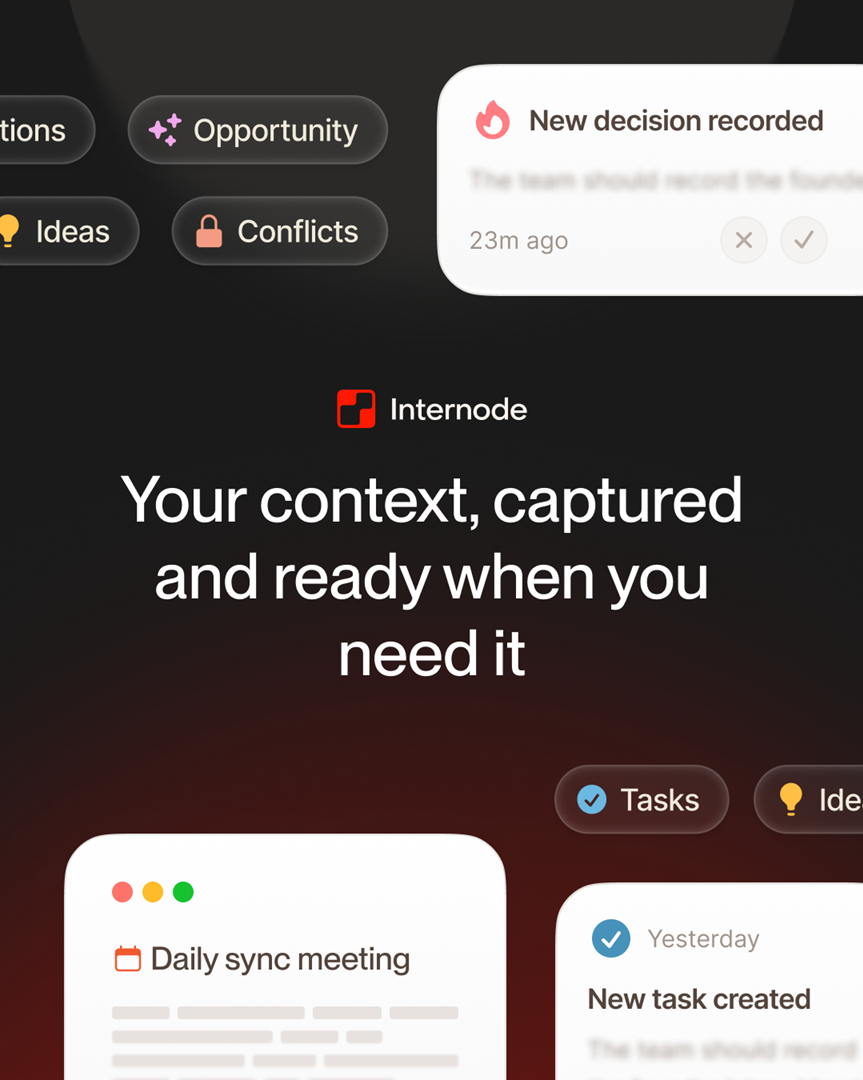
AI knowledge management for consultants is a system that ingests your client meetings, calls, and documents and returns a connected knowledge base you can query across every engagement. It is not a CRM and it is not a note-taking app. It is the layer that remembers what clients told you, organizes it by topic, and connects patterns across the different engagements you work on at the same time.
Consulting work generates more knowledge per hour than almost any other profession. Strategy calls, research interviews, stakeholder conversations, working sessions. Almost none of it ends up in a searchable form. The patterns live in your head until you have time to write them down, and you rarely do.
Why consulting knowledge is different
Most knowledge tools assume your information comes from documents you read and highlight. Consulting is the opposite. Most of what you know comes from conversations you had. A CFO mentioned a reorganization in a Tuesday call. A CEO dismissed a strategy you proposed three weeks earlier. A client’s head of operations walked you through how the current process actually works, which did not match the process described in their written policies.
None of that fits into a database with neat fields. It lives as context. The right tool has to ingest conversations as a first-class input and understand the relationships between what different people told you across different engagements.
The three failure modes consultants hit
Before describing what AI knowledge management does, it helps to name the failure modes it replaces.
First, information silos across tools. Notes in Google Docs, transcripts in Otter, decisions in email, to-dos in a notebook. Nothing is connected. When you prepare for a client meeting, you spend 30 minutes gathering context from five places.
Second, single-client thinking. Most consultants have a folder per client. That structure hides the pattern across clients. The regulatory change that three different clients mentioned in separate calls is not one entry anywhere. It lives only in your memory.
Third, synthesis lost on delivery. After a project ends, you write a final deliverable and move on. The learning you accumulated across 40 hours of meetings is compressed into a 20-page deck. Six months later, you cannot remember what the client actually said, only what made it into the final document.
What “AI knowledge management” actually does
A tool that solves these three failures has to do four things at once.
- Read conversations, not just documents. Meeting transcripts, call recordings, and dictated notes are the primary input. Documents and emails are secondary.
- Pull out the things you care about. Not just text chunks. A decision the client is weighing is saved as its own record. A commitment they made is saved as a task. A recurring subject becomes a topic that clusters every conversation that touched it.
- Connect across engagements. When the same subject appears in two different client calls, it is one topic with two sources, not two disconnected mentions. Topic clustering works across all the content you feed in, regardless of which client it came from.
- Answer questions with citations. You ask “what did the CEO at ClientX say about their expansion plans across the last three meetings?” and you get a synthesized answer with links to the transcripts where each claim came from.
This is what Internode does. Conversations go in. A structured knowledge base builds itself. Search and question-answering run over that base, not over a bag of transcripts. For the underlying model, see the AI knowledge base that builds itself.
Cross-engagement synthesis in practice
Here is what changes in a typical week.
You finish a Tuesday call with Client A about supply-chain risk. On Thursday, Client B mentions a similar vendor issue in passing. Friday morning, you ask your knowledge system “what have clients said about supply-chain disruption this quarter?” You get the two conversations linked to one topic, with the relevant quotes from each.
That pattern was invisible to you before. You would have needed to remember both calls and the connection between them. Now the system surfaces it, which changes what you can say in a proposal on Monday.
What about confidentiality
This is the objection every consultant raises, and it is the right objection. Two things matter. First, knowledge stays in your account and is not shared with other clients or other users. Second, the system is designed so you can scope search and generation to one engagement when you need to, without losing the cross-engagement pattern matching when you do not.
If your firm has stricter rules, check that the tool supports workspace isolation and data export. Internode keeps data scoped to your account and gives you the option to delete any conversation at any time.
Where to start
The fastest way to feel the difference: connect a week of client calls and try the synthesis. For a step-by-step version of the workflow, see how to synthesize knowledge across client meetings. For the broader framing of why CRMs and note apps cannot do this job, see the alternative to a CRM for consulting knowledge.
Start a free account at app.internode.ai and ask three cross-engagement questions you would normally hold in your head. The answers will tell you whether your current system was helping or hiding the pattern.
Related pages
- The AI knowledge base that builds itself
A knowledge base that builds itself takes meetings, calls, email, and chat as input and produces structured, citable knowledge as output. Nobody has to write pages, tag topics, or maintain folders. The system gets richer the more your team works.
- How to synthesize knowledge across client meetings
Synthesizing knowledge across client meetings fails when the work depends on your memory. The fix is a system that captures every conversation as structured records and clusters them by topic automatically, so the pattern across engagements is visible without you rebuilding it each time.
- The alternative to a CRM for consulting knowledge
CRMs were built to track contacts and deals. They do not track what people told you, what decisions the client is weighing, or how one engagement connects to another. Consultants need a different system: one that captures conversations, extracts the knowledge inside them, and connects what you learn across every client.
Next step
If this topic is relevant to your team, continue on the main site or explore the product directly.