Answer · · 5 min read
What is organizational memory?
Organizational memory is the layer of your team's knowledge that survives turnover, vacations, and forgetting. It is the structured record of decisions, tasks, topics, intents, and the conversations that produced them. Without it, every new hire, every new project, and every new AI agent starts from zero.
Updated:
organizational memory institutional knowledge decision memory knowledge management
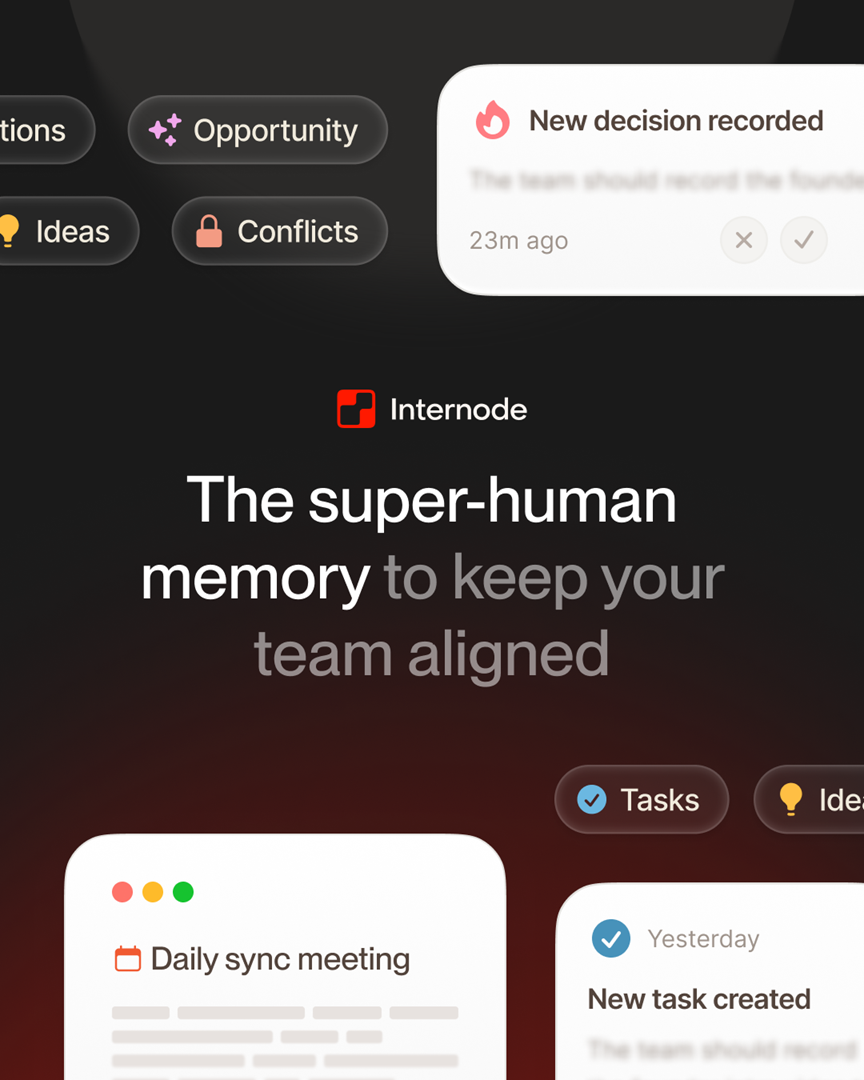
Organizational memory is the structured, searchable record of what your team has decided, agreed, and committed to over time. It includes the decisions themselves, the reasoning behind them, the people who made them, the tasks they spawned, and the conversations they came from. It is the layer of team knowledge that survives turnover, vacations, and the fact that no one writes everything down.
Most organizations do not have this layer. They have meeting transcripts that nobody reads, a wiki that is six months out of date, a Slack archive that is unsearchable by meaning, and one or two long-tenured people whose heads contain the actual record. When those people leave, the record leaves with them.
What organizational memory contains
Organizational memory is not “all the documents your team has ever produced”. A folder of PDFs is storage, not memory. The memory layer stores distinct records of decisions, tasks, topics, goals, and people, with real connections between them, so the system can answer questions about meaning, not just retrieve text by keyword.
A useful organizational memory contains six kinds of structure:
- Decisions. What was actually chosen, with the reasoning, the rejected alternatives, the people who agreed to it, and any earlier decision it replaced or updated. A decision is the smallest unit of organizational truth.
- Tasks. Action items with owners, status, deadlines, and a link back to the decision or conversation that created them. Tasks without that link become orphaned to-dos nobody can explain.
- Topics. Threads that group related discussions across many meetings, so a recurring subject (pricing, hiring, vendor selection) is one topic with many conversations, not many disconnected mentions.
- Goals. What the team is trying to accomplish, separate from the specific tasks. A goal (“make onboarding less painful”) survives across many tasks and many decisions.
- People and organizations. Recognized as real entities that connect across conversations, so “the CFO” mentioned in three meetings is one person with three contributions.
- Who said what. The position each participant took during a discussion, so the system can distinguish a proposal from a conclusion and preserve dissenting positions.
These six together produce a record in which a question like “why did we pick this vendor and what tasks did that decision create?” has a real answer, traceable back to a specific meeting and a specific person.
Why memory is different from search
Search retrieves text. Memory retrieves structure.
A search system, even a good one that uses semantic similarity, will return passages from your archives that look like your query. It cannot tell you which passage was a proposal that got rejected and which one became the actual decision. It cannot follow the chain from a decision to the tasks it created. It will happily surface a casual statement as if it were a commitment.
A memory system stores the answer in a form search can rely on. The decision is stored as a decision, with a status, the reasoning behind it, the meeting it was made in, and the earlier decision it replaced. Asking “what is our current vendor decision?” returns one decision, not twenty mentions ranked by similarity. For a deeper version of this distinction, see decision memory versus vector databases and why AI agents need decision memory.
What teams use organizational memory for
Once the memory layer exists, the workflows that depend on it become structurally easier:
- Onboarding. A new hire asks the system questions instead of shadowing a senior teammate for three months. The answers are grounded in real history.
- Cross-team coordination. Two teams working on adjacent projects can ask “what has the other team decided about the shared interface?” and get a real answer, not a meeting invite.
- Decision review. A leader reviewing the past quarter can pull every decision in a topic, see who agreed to each, and see which earlier decisions were modified or rejected.
- AI grounding. Agents and copilots that need to know what the team has actually committed to can query the memory instead of hallucinating organizational facts. This is why organizational memory matters for AI agents.
- Continuity across leave. When the person who held the context goes on PTO, the team is not paralyzed. The memory is in the system, not the person.
What memory is not
Some clarifications, because the term gets used loosely:
- It is not a wiki. A wiki is something a human writes. Memory is something the system extracts from conversations the team is already having.
- It is not a transcript archive. A transcript captures everything and surfaces nothing. Memory captures the small set of things that actually mattered.
- It is not a copilot’s chat history. A chat thread is a single user’s conversation with an AI. Memory is the team’s shared record across many people, many tools, and many years.
- It is not “decision memory” alone. Decisions are the most important slice, but tasks, topics, goals, and people round out the structure. Decision memory is the sharpest subset.
How an organizational memory gets built
If memory is so useful, why is it rare? Because the cost was always in the wrong place. Old knowledge management asked humans to write the memory by hand. They never did, consistently, because the people with the knowledge were also the people doing the work that produced it.
A modern organizational memory layer does the work the other way around. The conversations themselves (Zoom and Google Meet recordings, Slack threads, email, phone calls) are the input. A connected record of decisions, tasks, topics, goals, and people is the output. Humans review the changes the system proposes. Nobody writes pages.
Internode is built on this model. Meetings, calls, and messages come in automatically. Decisions, tasks, and topics are pulled out and matched against what already exists so the same decision does not appear twice. The chat agent answers questions grounded in that record and proposes changes (creating tasks, updating decisions, moving work between projects) that a human approves with one click. Tasks sync both directions with Linear and Jira, so engineers keep their existing tools current.
If your team’s institutional knowledge currently lives in two or three people’s heads, the next reading is what is institutional knowledge and why teams lose it. If you want to see what changes once the memory layer is in place, read what changes when your team actually remembers what was decided.
Related pages
- What is organizational memory for AI agents?
Organizational memory gives AI agents persistent, structured knowledge about a team's decisions, reasoning, context, and commitments instead of forcing them to reconstruct everything from raw documents on every query.
- What is decision memory?
Decision memory is the sharpest subset of organizational memory: the structured record of what your team actually chose, why, who ratified it, and what changed afterward. It is not a category to sell, but it is the part of team knowledge most worth getting right.
- What is institutional knowledge and why teams lose it
Institutional knowledge is the accumulated understanding of how and why your organization does what it does. Teams lose it when experienced staff leave, decisions go undocumented, and critical context lives only in people's heads instead of a shared record.
Next step
If this topic is relevant to your team, continue on the main site or explore the product directly.