Answer · · 4 min read
What is decision memory?
Decision memory is the sharpest subset of organizational memory: the structured record of what your team actually chose, why, who ratified it, and what changed afterward. It is not a category to sell, but it is the part of team knowledge most worth getting right.
Updated:
decision memory organizational memory decision tracking knowledge management
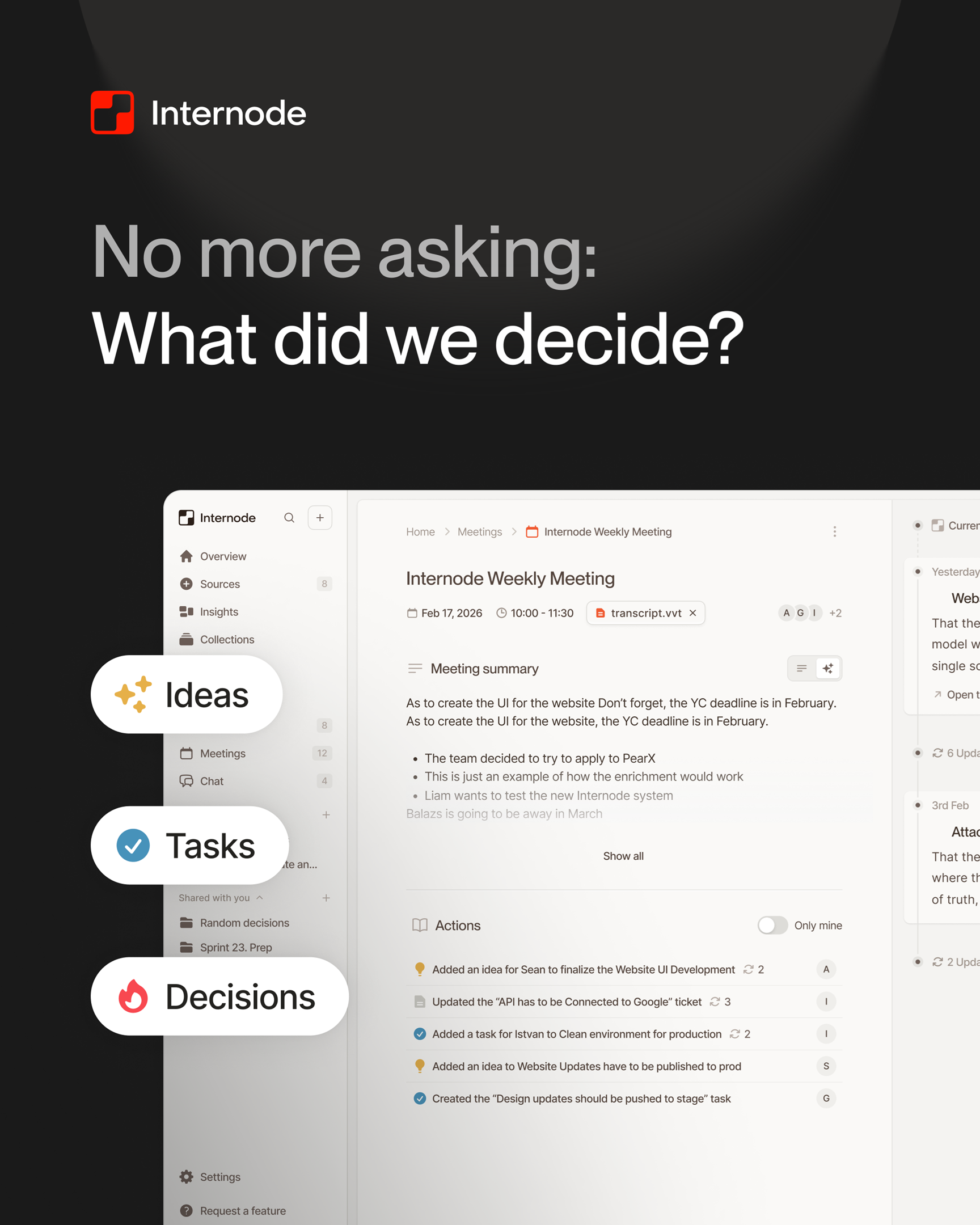
Decision memory is the structured record of the decisions a team has actually made, not just discussed. Each decision carries its rationale, the people who ratified it, the alternatives that were rejected, and any earlier decision it replaced. It is the sharpest subset of organizational memory: the part most often missing, and the part most expensive to lose.
Most teams produce decision memory by accident, badly. Notes from a meeting capture some of it. A Slack thread captures another piece. A wiki page tries to summarize it after the fact. None of these are the same shape as a decision, so they do not retrieve like a decision. The question “what did we decide about pricing?” comes back as twenty messages, not one answer.
Decision memory inside organizational memory
Organizational memory is a connected record of decisions, tasks, topics, goals, people, and the positions each person took. Decision memory is the slice that covers the decisions themselves plus the links that connect each decision to the work it produced and the earlier decisions it modified.
The reason decisions get a name of their own is structural. Most of the other records exist to support decisions. A topic is a cluster of discussions that produced or will produce decisions. A task is the work that follows from a decision. A goal is what a series of decisions serves. People are the participants who agreed, opposed, or proposed. The decision is the smallest unit that says “this is the team’s current truth”, and the rest of the record hangs off it.
That is why a team can have a wiki, a meeting archive, and a chat history and still not know what was decided. The other artifacts exist. The decision structure does not.
What a decision-memory record contains
A useful decision record is more than a sentence. It carries:
- The conclusion. The actual choice the team made, in plain language.
- The reasoning. What led there, including the considerations that mattered.
- The rejected alternatives. The options that were considered and not picked, with the reason each was rejected.
- The participants. Who proposed it, who supported it, who opposed it, who agreed to it. A decision with no named owners cannot be relitigated honestly.
- The source. The meeting, call, or thread where the decision was made, with a link back so the record can be audited.
- The history. Whether this decision modifies, replaces, or rejects an earlier one, and whether a later decision has done the same to it.
Internode stores all of this directly. A decision carries its conclusion, its reasoning, its source, the people who agreed to it, and explicit links to the earlier decision it replaced, modified, or superseded. Tasks that followed from the decision link back to it. Topics group decisions by subject. The team asks questions in plain English and the answers come back with the source attached.
Why teams lose decision memory
Three structural reasons, in order of cost:
- The decision was never named. A discussion ended with implicit agreement, not an explicit decision. A week later, two participants disagree about what was decided. There is no record because the team did not write one, because nobody was the appointed scribe, because being the scribe is a thankless job.
- The decision was named but not preserved. Someone wrote it in a meeting note, a Slack thread, or an email. That artifact is now buried in a sea of other artifacts. Search by keyword returns it alongside fifty other near-matches. Search by meaning is not available because the storage is text, not structure.
- The decision was preserved but the rationale was not. The team remembers the conclusion. Nobody remembers why. Six months later, the constraint that drove the decision has changed, but the team is still operating as if it has not.
Each of these failure modes is the absence of structure, not the absence of effort. Adding more notes does not fix it. A different shape of storage does.
For the everyday symptom of these failures, see why your team keeps rediscussing the same decisions. For the AI-side consequence, see why AI agents need decision memory.
What decision memory unlocks
When the decision-typed slice of your knowledge base actually exists:
- “Why did we choose this vendor?” returns the decision, the reasoning, and the rejected alternatives, not a search-result list.
- “What changed since the last time we revisited this?” returns the chain of updates and replacements, not a guess from a transcript.
- “Who approved this?” returns named participants, not an email someone half-remembers.
- A new hire reading the decision can understand the team without sitting through six months of meetings.
- An AI agent answering for the team has a stable record to ground in instead of inferring from fragments.
How decision memory relates to the broader picture
Decision memory matters most when the team is large enough that not everyone was in every meeting, but small enough that decisions still happen in conversations. That covers almost every operating team. The bigger the team, the more memory you need; the smaller the team, the more conversational the memory tends to be, and the less likely it is to be written down.
The tools that work for this are the ones that capture decisions from the conversations themselves and store them as decisions, not as transcripts. Wikis fail because they require a second writing step. Transcript archives fail because they preserve everything and structure nothing. Meeting-notes tools fail because they end at the meeting boundary. A decision-memory layer has to span every conversation, every channel, every week.
Internode is built around this idea. If you want the broader category context, start with what is organizational memory. If you want to see what changes when the decision layer actually works, read what changes when your team actually remembers what was decided.
Related pages
- What is organizational memory?
Organizational memory is the layer of your team's knowledge that survives turnover, vacations, and forgetting. It is the structured record of decisions, tasks, topics, intents, and the conversations that produced them. Without it, every new hire, every new project, and every new AI agent starts from zero.
- Why AI agents need decision memory
AI agents become more useful when they can reuse prior decisions and reasoning instead of rebuilding context from raw transcripts on every question. Decision memory is the difference between an agent that sounds informed and one that actually is.
- Why your team keeps re-discussing the same decisions
Your team is not forgetful. The problem is structural: what gets agreed in meetings is not captured in a way anyone can find later. When the reasoning behind a decision disappears, people rationally reopen the discussion.
Next step
If this topic is relevant to your team, continue on the main site or explore the product directly.