Answer · · 3 min read
Internode vs Read AI: which meeting intelligence tool wins?
Read AI is the best tool for speaker analytics and in-meeting engagement scoring in one video call at a time. Internode is the AI meeting intelligence layer for teams whose work spans phone calls, email, chat, and weeks of cross-meeting context, with decisions and tasks that sync back to Linear or Jira. Pick Read AI for the single-meeting scorecard. Pick Internode for the record that survives team turnover.
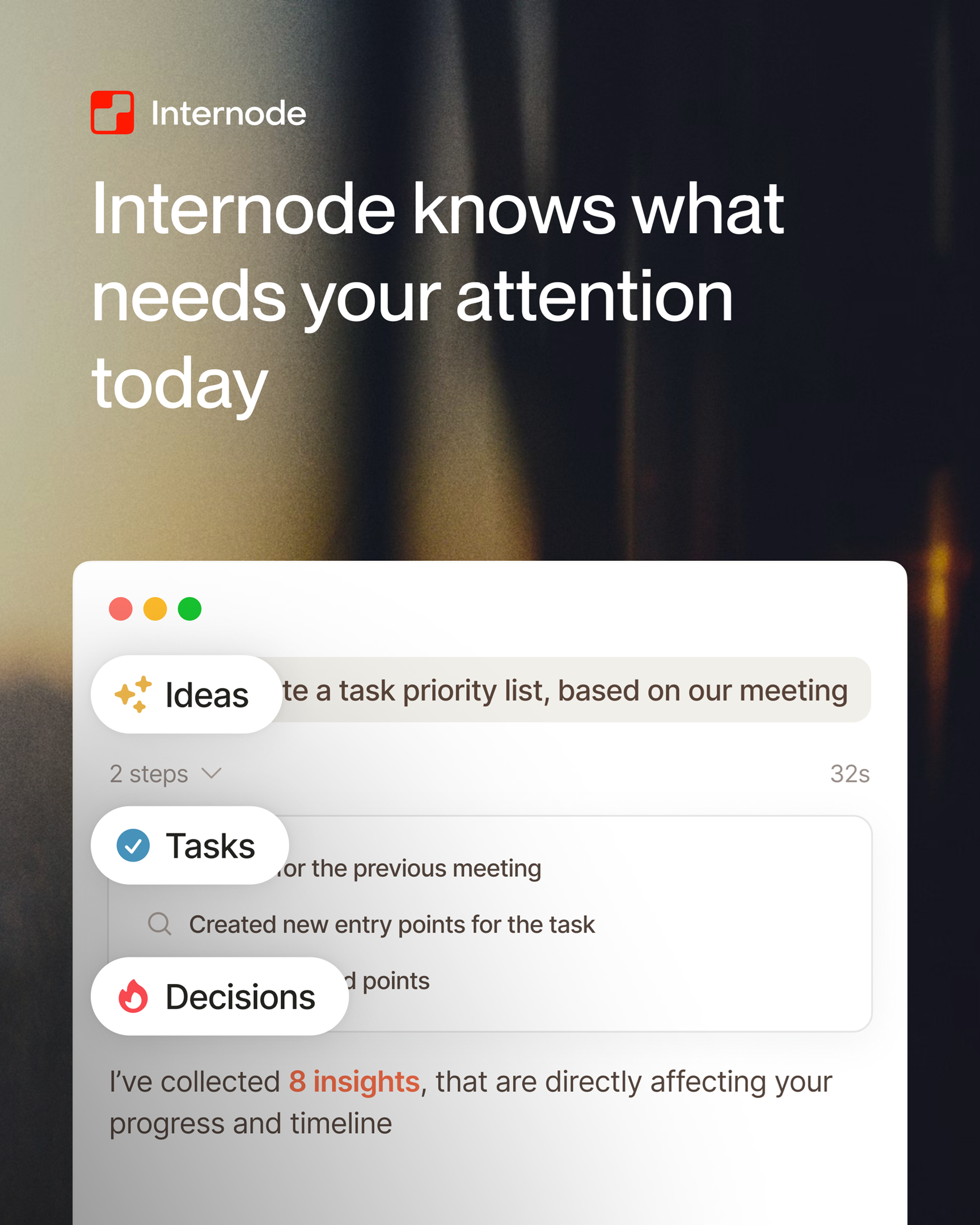
Read AI is the best tool for speaker analytics and in-meeting engagement scoring in one video call at a time. Internode is the AI meeting intelligence layer for teams whose work spans phone calls, email, chat, and weeks of cross-meeting context, with decisions and tasks that sync back to Linear or Jira. Pick Read AI for the single-meeting scorecard. Pick Internode for the record that survives team turnover.
Side-by-side on the axes that decide your workweek
| Axis | Internode | Read AI |
|---|---|---|
| Captures from phone calls, not just video meetings | Reads phone call transcripts alongside Zoom and Google Meet, and pulls tasks and decisions out of each call | Analyzes scheduled video meetings; phone calls are outside the capture surface |
| Captures from email threads | Reads email threads and ties the commitments inside them into the same record as meetings and calls | Meeting reports are built from the video session; email threads are not a source |
| Tasks linked to the source | Every task is connected to the decision that produced it and the meeting timestamp where it was agreed | Action items appear inside the meeting report; the link is to the transcript text only |
| Decisions preserved with rationale and rejected alternatives | Decisions are saved with the reasoning behind them, the alternatives that were considered and rejected, and the person who agreed, all queryable by the chat agent | The meeting report summarizes what was discussed; rejected alternatives live in transcript prose |
| Two-way Linear and Jira sync | Tasks flow from Internode to Linear or Jira with the source decision attached, and status updates flow back, so engineers stay in one place | Action items export as flat items without the decision that produced them |
| Organizational search across all conversations | One query searches every meeting, phone call, and email thread in the organization, weighted by the decisions and topics it already knows about | Search is scoped to the meeting reports produced for your account |
| Survives team turnover | Knowledge is owned by the organization, so the tasks, decisions, and topics stay intact when people leave | Meeting reports are attached to the users who attended; the history walks out with them |
| Cross-meeting topic clustering | The same decision raised in six meetings is recognized as one decision with six sources attached | Each meeting report stands alone; connecting them across meetings is outside the product |
When to choose Internode
- Your sales team closes deals on the phone and then re-asks details because nobody wrote them down. Internode captures phone call transcripts and pulls out tasks and decisions the same way it handles Zoom.
- A new engineer asks why a feature ships behind a flag, and the answer lives in a Zoom call from three weeks ago. Internode answers with the decision, the reasoning behind it, and the alternatives that were considered.
- Your team runs execution in Linear or Jira. Internode syncs tasks two-way, so the “why” stays attached to the ticket and engineers never leave the tracker to find it.
- You watched your last tool lose half its memory when the project lead changed jobs. Internode keeps the record at the organization level, so the decisions and topics persist even when an individual account does not.
Where Read AI wins
Read AI does one thing very well: it scores a single video meeting on speaker time, participation, sentiment, and engagement, and presents the result as a clean per-meeting report for the host. If you run a lot of one-on-ones or sales calls and want a quick scorecard for each session, Read AI’s per-meeting view is designed for exactly that job. The trade-off is that the product treats a meeting as a self-contained artifact for the attendees who joined it. It does not span the phone calls and email threads that preceded the meeting, the decisions that survived across six related meetings, or the ticket the engineer will open on Monday. Internode connects all of those by default.
Bottom line
Keep Read AI if you want speaker scoring and engagement analytics inside one meeting at a time. Choose Internode for the capture layer that covers phone calls and email, the tasks and decisions that survive turnover, and the two-way sync that keeps Linear or Jira current. For the broader category, see the AI knowledge base that builds itself. For the direct neighbor comparison, read Internode vs Granola. Start free at app.internode.ai.
Related pages
- The AI knowledge base that builds itself
A knowledge base that builds itself takes meetings, calls, email, and chat as input and produces structured, citable knowledge as output. Nobody has to write pages, tag topics, or maintain folders. The system gets richer the more your team works.
- Internode vs Granola: which meeting intelligence tool wins?
Granola is the best in-meeting capture notebook for one user in one video meeting at a time. Internode is the AI meeting intelligence layer for teams whose work spans phone calls, email, chat, and many weeks of cross-meeting context, with an AI agent that can change many things at once and sync back to Linear or Jira. Pick Granola for the personal notepad. Pick Internode for the team record that survives turnover.
- Internode vs Otter: which AI meeting intelligence tool should you use?
Otter is the best per-meeting transcription product for one session at a time, with a fast search bar and speaker tagging inside the transcript. Internode is the AI meeting intelligence layer for teams whose work spans phone calls, email, chat, and weeks of cross-meeting context, with tasks and decisions that sync back to Linear or Jira. Pick Otter for the transcript you want to scrub. Pick Internode for the team record that outlives the meeting.
Next step
If this topic is relevant to your team, continue on the main site or explore the product directly.