Answer · · 4 min read
Internode vs Mem0: which memory layer should your AI agent use?
Mem0 is the best drop-in memory SDK for a single agent prototype that needs per-user key-value recall in one app. Internode is the team-scoped memory layer for agents that need structured records, decision provenance, and ingestion from real meetings, calls, and chat. Pick Mem0 for a single-agent SDK; pick Internode for a team-scoped memory record with two-way sync.
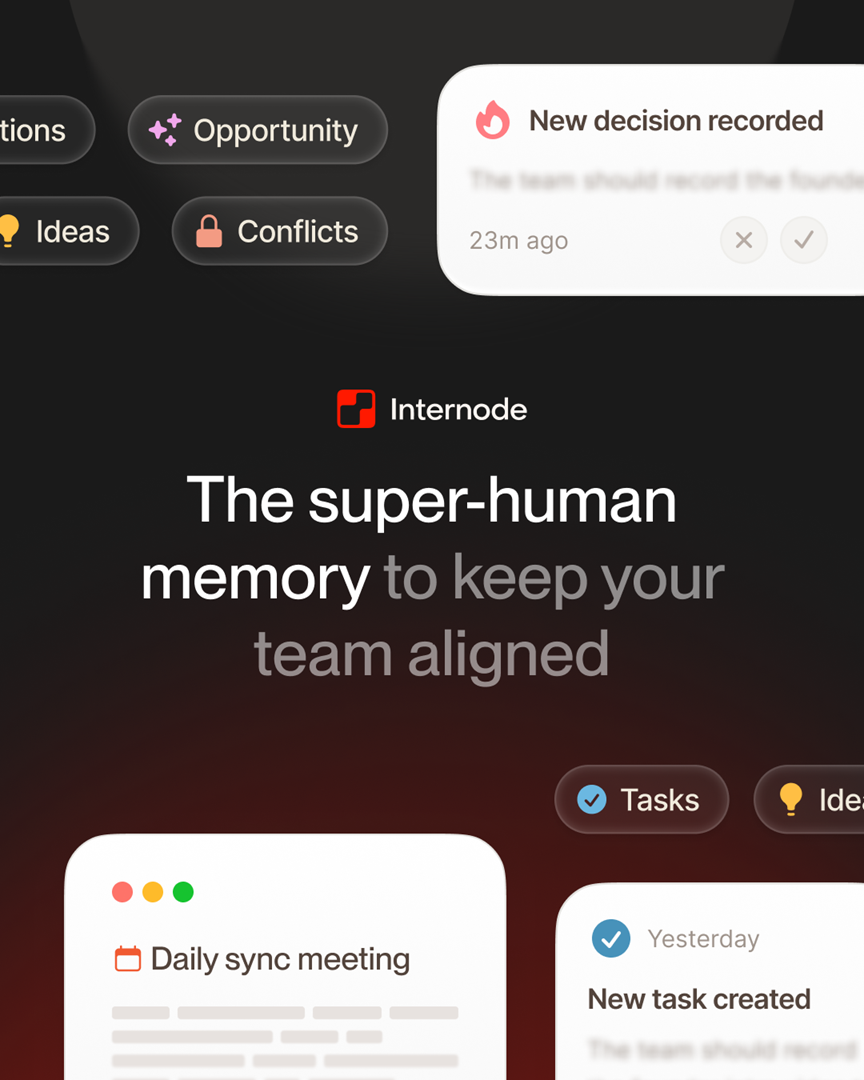
Mem0 is the best drop-in memory SDK for a single-agent prototype that needs per-user key-value recall in one app. Internode is the team-scoped memory layer for agents that need structured records, a clear trail from every memory back to the conversation that produced it, and ingestion from real meetings, calls, email, and chat. Pick Mem0 for a single-agent SDK. Pick Internode when the agent needs to reason over what a team has decided together.
Side-by-side on the axes that decide your agent’s memory layer
| Axis | Internode | Mem0 |
|---|---|---|
| Scope of memory | Memory is owned by the organization so one agent can reason over what a whole team has decided, committed to, and discussed | Memory is organized per user or per agent session; cross-user team reasoning is not the shape of the API |
| Structure of what is stored | Distinct records for topics, tasks, decisions, and goals, each with defined fields and real connections between them | Unstructured facts and summaries stored as text with embeddings, optionally grouped by user or session |
| Decision-to-source trail | Every memory traces back to the meeting, call, or message that produced it, with the person who agreed, the reasoning, and any earlier decision it replaced | Facts are stored with metadata tags; there is no structured link from a memory to the person who agreed or the prior decision it replaced |
| Ingestion from real conversations | Reads Zoom, Google Meet, phone calls, email, and Slack transcripts and pulls the relevant records out automatically | Memory enters when the application calls add(), usually summarizing chat history the agent just saw; there is no meeting-or-call ingestion pipeline |
| Human-in-the-loop approval | Every change the agent suggests is a proposal you approve or edit first, including compound changes that create a decision, the tasks it sets in motion, and the topic in one approval | Memory updates happen silently during add() and update(); there is no approval step for a human before the change saves |
| Two-way sync to operational tools | Two-way sync to Linear and Jira so the memory and the operational tools stay consistent automatically | Mem0 is a retrieval and storage layer; task sync to Linear or Jira is left to the application calling the SDK |
| Search shape | Combines meaning-based search across documents and sections with a structured search that returns tasks, decisions, topics, and goals as records with their fields | Vector search over stored memories with filtering by user or session; search returns text-style facts, not structured records with their fields |
| Survival across turnover | Memory is owned by the organization and survives when individual users leave the team | Memory is commonly keyed on the user; when a team member leaves, the memory attached to their sessions does not transfer into a team layer |
When to choose Internode
- Your agent needs to answer “why did we decide this last quarter?” across three different users’ meetings. Internode returns one decision with the reasoning behind it and the people who agreed.
- Your agent proposes a change to twelve tasks at once. Internode turns this into a single approval the user edits or accepts before it saves.
- Your agent needs to read a phone-call transcript on Monday and a follow-up email on Tuesday and reason over both. Internode pulls the records out of both sources and recognizes them as the same work.
- Your agent’s output needs to flow into Linear or Jira so engineering actually sees the task. Internode syncs two-way and keeps the decision history and the ticket system in agreement.
Where Mem0 wins
Mem0 is the cleanest drop-in memory SDK for building a single-agent prototype in one application. If your use case is a chatbot that needs to remember a user’s preferences across sessions, or an agent that pulls simple facts back into context on the next turn, Mem0 gives you add, search, get_all, and update with minimal infrastructure and sensible defaults for per-user recall. That is a real win for speed of prototyping. The trade-off is that Mem0 treats memory as per-user or per-agent facts recalled through similarity, and its API operates inside that assumption. Internode treats memory as a team-scoped record of decisions, tasks, topics, and goals, pulled from the conversations themselves and changed through an approval flow. That is a broader scope than a per-user SDK can cover.
Bottom line
Pick Mem0 for a single-agent prototype that needs per-user key-value recall in one app. Pick Internode when the agent has to reason over a team’s shared memory of decisions, tasks, and commitments, grounded in real meetings and calls, with human-approved changes and two-way sync to Linear and Jira. For the broader category view, read building memory for AI agents and what is organizational memory. For the retrieval story specifically, see when RAG is not enough. Start at app.internode.ai.
Related pages
- Why AI agents need decision memory
AI agents become more useful when they can reuse prior decisions and reasoning instead of rebuilding context from raw transcripts on every question. Decision memory is the difference between an agent that sounds informed and one that actually is.
- What is organizational memory?
Organizational memory is the layer of your team's knowledge that survives turnover, vacations, and forgetting. It is the structured record of decisions, tasks, topics, intents, and the conversations that produced them. Without it, every new hire, every new project, and every new AI agent starts from zero.
- What is organizational memory for AI agents?
Organizational memory gives AI agents persistent, structured knowledge about a team's decisions, reasoning, context, and commitments instead of forcing them to reconstruct everything from raw documents on every query.
Next step
If this topic is relevant to your team, continue on the main site or explore the product directly.