Answer · · 4 min read
AI phone call transcription for small business: calls to knowledge
AI phone call transcription for small business turns every call with a customer, supplier, or crew into a written record your whole team can search. The right tool pulls out the price, the order, the date, and the follow-up, so a detail from a Tuesday call does not get lost by Friday.
Updated:
phone call transcription small business ai meeting notes call tracking
AI phone call transcription for a small business is about turning the calls you already take into a written record you can search, not about recording every word. The customer who changed the delivery address. The supplier who agreed on a price. The crew lead who promised a job site time. Right now that information lives in somebody’s head. With a transcription tool that understands your work, the same information lives in one place your whole team can use.
Why phone calls are your biggest leak
You run the business off your phone. A good share of what keeps your company alive happens on those calls: the quote, the order, the change, the promise.
You mean to write things down. You do not always get to. Your colleague takes the next call and hears a different detail. The voicemail you left yourself disappears into a folder. By Friday, three customers are asking about three things and nobody can find the original conversation. That is not a memory problem. That is a tool problem.
The most common fix people try is a CRM. Most small businesses install one, give up on it in two weeks, and go back to sticky notes. A CRM asks you to type. Phone calls do not give you time to type.
What transcription alone will not fix
Recording and transcribing a call is step one. Your phone can already do this. An iPhone, a Pixel, or a simple app turns a call into text in seconds. That part is solved.
The harder part is what happens next. A raw transcript of a 12-minute call is hard to read. Nobody opens 40 transcripts to find one price. You do not want another folder. You want to ask “what did Maria from Henderson Glass agree to on the window order?” and get the answer, not a wall of text.
That is the gap a small business tool needs to close. See how to turn phone calls into searchable business knowledge for the full capture flow.
How Internode turns a call into knowledge
Internode was built to ingest phone calls directly. You can upload a recording from your phone, connect a desk line, or drop a transcript. The tool reads the call and pulls out the parts that matter to the business.
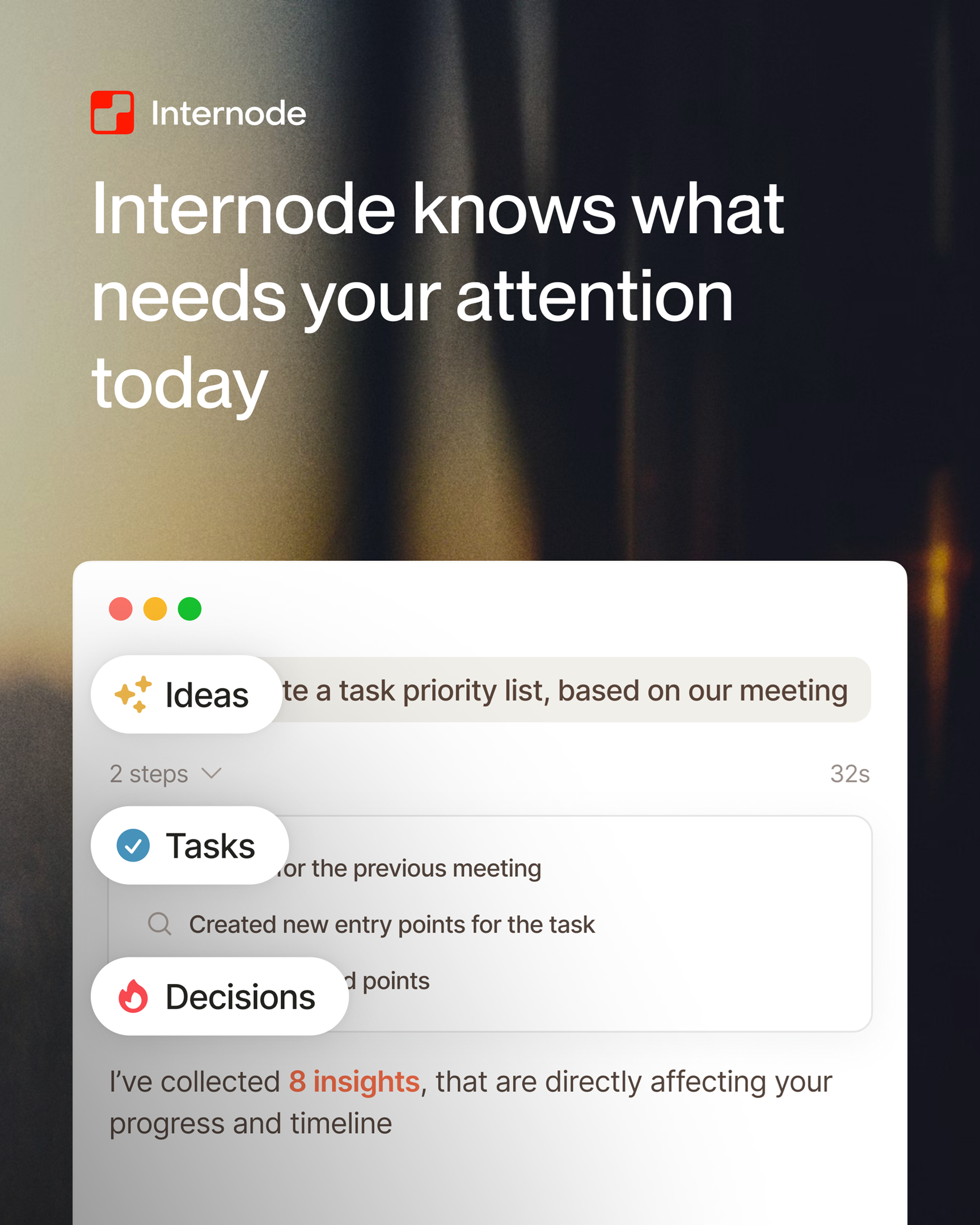
For every call, you get a short structured record: the people on the call, the decisions made, any tasks created, the prices and dates mentioned, and a link back to the original transcript so you can always see the exact words. If the customer agreed to a new delivery date, that becomes a task with a due date. If the supplier quoted a price, that becomes a decision you can find later by searching the supplier’s name or the product. If your staff agreed on a refund, the agreement is recorded next to the reason.
What you end up with is not a generic transcription service. Think of it as a small-business brain that listens to the calls and remembers on everyone’s behalf.
What you can search after one week
Most people see the value the first time they need a detail from a call they do not remember clearly.
You can ask “what did the customer say about the delivery window?” and get the exact line from the call. You can ask “what price did we agree with the paint supplier last month?” and get the quote and the date. You can ask “what did the service tech promise on Tuesday?” and get the commitment plus the customer.
You can also ask broader questions. “Which customers asked about the new product line this month?” “Which suppliers raised prices since January?” “What complaints came in last week?” The tool groups related calls by customer, supplier, topic, and date, so patterns become obvious. You stop relying on the one employee who remembers everything.
The practical effect is that new employees can read what actually happened instead of learning the business through folklore. See why small businesses forget what was decided and how to fix it for more on that shift.
How this connects to the work you already track
If your crew uses a simple task tracker, a spreadsheet, or a shared email folder, Internode can connect to it both ways. A commitment made on a call can become a task in Linear or Jira if your team uses one, or a line in your existing sheet if they do not. When the task is marked done, the system reflects that.
For most small businesses, the first win is simpler than any sync. The team stops asking the owner “what did that customer want again?” because the answer is already in the tool. The owner stops being the human backup drive for the business.
What you can do today
You do not need to sign up for anything yet to test the idea. Pick your next important call. Record it on your phone. Hang up. Spend two minutes getting the text.
If you do that for five calls in a week, you will already see the pattern. Some details you would have forgotten. Some commitments you would have missed. Some prices you would have had to ask the customer to repeat. Multiply that by a year and you see the cost.
Then the only question is whether your team keeps paying that cost, or whether you put the calls somewhere everyone can find them. How small businesses stop losing information from phone calls walks through what changes after you do.
Related pages
- How small businesses stop losing information from phone calls
Small businesses stop losing information from phone calls by recording and transcribing those calls, then organizing the transcripts so the whole team can find customer requests, pricing agreements, delivery dates, and follow-up actions without relying on memory.
- Why small businesses forget what was decided and how to fix it
Small businesses forget what was agreed because most agreements happen in phone calls and conversations that nobody records. The fix is simple. Transcribe those conversations and use a tool that pulls out the commitments, assigns owners, and makes everything searchable.
- How to turn phone calls into searchable business knowledge
Your phone (ex: iPhone or Samsung) can already transcribe calls. The harder part is turning those transcripts into something your team can actually use and act on, without you reading through every word and filing it by hand.
Next step
If this topic is relevant to your team, continue on the main site or explore the product directly.